
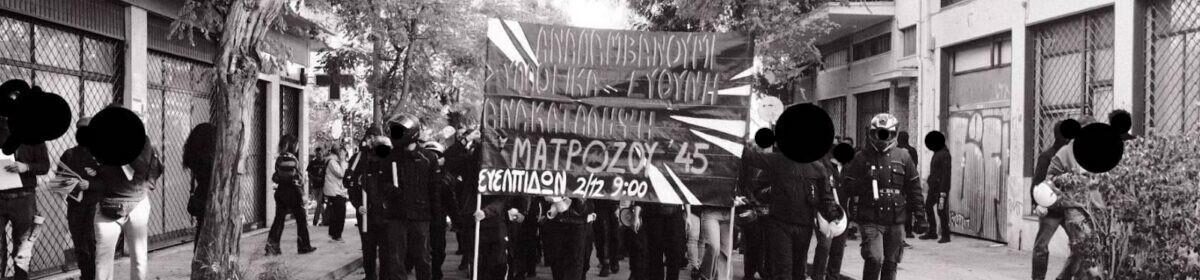
On 30/4, comrades are being tried on appeal for the militant/decisive/resistant defense of the buildings of the Koukaki Squats Community in January 2020, following an adjournment on 2/12/2025. An adjournment was decided by the court after the unprecedented absence of the 4 cops-accusers, aiming to weaken the support gathered around the trial, a rally clearly declaring collective responsibility for the re-squatting of Matrozou. The previous campaign (October-December 2025), through a series of events and interventions, highlighted both the issue of possible imprisonment of the squatters and the necessity of defending squatted grounds. This campaign continues until the final acquittal of our comrades. No state maneuver, such as repeated adjournments, will wear us down.
The Koukaki Squats Community was created in 2017 and consisted of 3 abandoned houses (Matrozou 45, Panaitoliou 21, Arvali 3) which, through collective effort, became habitable again and operated as housing and political squats for about 3 years. The doors of the squatted buildings were open to those who wished to counterattack state violence and injustice, to those needing shelter or the community’s solidarity structures, to those seeking a collective way of living, as well as to the people of the neighborhood. Besides assemblies and the events, the squats hosted a lending library, public showers and laundries, and a clothing exchange bazaar. The Community was involved in struggles for squats, antifascism, political prisoners, against gender-based violence, patriarchy, racism, environmental exploitation, struggles against gentrification, the privatization of Filopappou Hill, the touristification of Koukaki, and more.
During those three years, the houses were targeted by three fascist arson attacks and repeated evictions, with police using every form of violence against the squatters or anyone obstructing state plans. The houses, till today – six years after the last evictions- are left to decay, while the state has initiated their sale to real-estate companies to be turned into expensive luxury apartments in the highly touristic Koukaki neighborhood. The building at Arvali 3 has been sold to an Israeli company, case in point. Residents actively defended the houses during every police invasion (six evictions in total), resulting in prosecutions for their political choices. The upcoming trials are scheduled on 30/03 (Appeal court of Panaitoliou), on 30/4 (Appeal court for Matrozou) and on 5/5 (Trial of supporters at Matrozou). As in previous cases, our comrades will defend their imperatives, their relationships, the struggles fought, and the structures they have created.
The demand for the imprisonment of our comrades came officially and publicly from political authorities. Footage of the eviction flooded the mass media, with calls for “exemplary punishment,” including statements by the Prime Minister K. Mitsotakis and the Minister of Citizen Protection M. Chrisochoidis. The political authorities further intervened in support of the prosecution: less than a month after the fiasco of the arrest of D. Indares, a neighbor of Matrozou 45 who was beaten on his rooftop after the police failed to locate the squatters, the police filed a lawsuit against our comrades. The case was taken up by Plevris’ law firm, along with various other opportunistic lawyers acting as cop defenders. His associate and New Democracy parliamentary candidate, E. Varela, initially attempted to appear as a civil plaintiff against the squatters; however, she was ultimately dismissed from the courtroom. She later lied on a television program about the outcome of the first-instance court, in an attempt to extract political gain from the case. To make matters worse, representatives of the Greek police filed another complaint and lodged a complaint with the prosecutor for not pressing felony charges against the defendants for attempted homicide. The latest development highlighting the state’s hostility toward our comrades is the lawsuit filed last August, accusing them of causing damage to police uniforms and demanding compensation.
Political pressure led the first-instance court to exercise the full rigor of the law, sentencing our comrades to 6.5 years with suspension pending appeal. In another case, two cops who were criminally prosecuted for beating and severely injuring an elderly man were acquitted, as the victim “could not identify exactly who had hit him”. However, in the Koukaki case, the court ultimately convicted our comrades, despite the police being unable to identify any individuals, a decision once again demonstrating the selective stance of the judicial authority.
This specific case is significant because, apart from the repression against squats, the potential imprisonment of our comrades will normalize the strictness of the new penal and correctional code, which has already paved the way for the imprisonment of a broader segment of protesters even with misdemeanor charges. The new penal code, with its overall increase in maximum sentence limits and the simultaneous tightening of conditions for probation or commutation, makes the full or partial serving of a sentence mandatory in many cases. Not only does this make it easier for many people to end up imprisoned, but incarceration itself becomes even harsher, with longer time served, stricter conditions for parole, and cuts to prisoners’ rights to communication and temporary leaves. Combined with the recent anti-immigrant law, the racist dimension of the code is reflected in provisions that criminalize lack of documentation, reinstate deportation as a “security measure,” allow administrative deportation even before a judicial decision is issued, increase fines for lack of documentation, and extend detention periods in immigrant detention centers. It is more than clear that the state’s new penal arsenal increasingly criminalizes practices of survival and resistance, expanding the range of social groups facing imprisonment. Our comrades’ trial for the re-squatting of Matrozou, although technically falling under the provisions of the previous penal code, took place within the temporal and political context of the implementation of the new penal code.
The evictions of the Koukaki Squats’ Community houses were part of an organized plan of state repression against squatted spaces nationwide, aiming to weaken the anarchist movement. The infamous 15-day ultimatum to squatters (“Chrysochoidis’ ultimatum”) to either vacate or legalize all squats in the winter of 2019 fell flat. Re-squatting, new squats, and a wave of solidarity with those defending the grounds of struggle unfolded in the following period. The repressive plan was complemented by laws restricting demonstrations, preventive arrests, and curfews during quarantine, thereby establishing the doctrine of law and order. A doctrine aligned with the notion of “national security,” in the name of which immigrants are killed at the borders. At the same time, prison populations skyrocket under flimsy and fabricated charges (such as the cases of A. Floros, the two volunteer firefighters from Patras, among others). Attacks on squats and whoever struggles for a self-organized non-authoritarian society go hand in hand with the new penal code’s severity and the further devaluation of life (e.g., inflation, precarious employment contracts, 13-hour workdays, restrictions on union rights, student disciplinary actions and expulsions, privatization in health, education, and public transport, housing crisis, transfer of public spaces to private hands, destruction of the natural environment). Squats and their communities remain internal enemies of the state. Against state killings (e.g., Tempi, Pylos), the genocide in Palestine, and interstate interests, we fight for a world without wars, borders, or states. Against killings by cops and bosses (e.g., cases of Violanta factory, Sampanis, Fragkoulis, Manioudakis, Karyotis), we respond with rage, and we fight for a world without divisions and discrimination. These imperatives flourish within squats and reflect another world.
Today, the state is attacking the squatted neighborhood of Prosfygika, using the pretext of constructing social housing to orchestrate the eviction of 400 people and uproot social structures. This squat community, established in 2010, is a vibrant neighborhood of resistance in the city center. Aristotelis Chantzis, resident and member of the Prosfygika community, is on a hunger strike unto death, opposing the repressive plans of the Attica regional government and raising a barrier of resistance against state designs.
Squats address social needs
Squats provide collective solutions to fundamental and seemingly individual needs: housing, electricity, water, food, and clothing. Beyond these, certain spaces host healthcare anti-structures (e.g., the Exarchia Self-Organized Health Structure), production initiatives (e.g., VIO.ME), as well as music studios etc. In these spaces, we strive to create an environment of self-protection against gender-based, racist, and all forms of authoritarian violence. They are living examples of collective expression, self-organization, solidarity, and mutual aid in opposition to the capitalist way of life.
They are means of struggle
They are spaces for organizing political and social struggles and social centers in neighborhoods. They are also tools of struggle for social/political mobilizations, such as squats during major strikes or hunger strikes, solidarity squats for Palestine, university and school squats, squats of production facilities, and land squats against environmental plunder. The radical nature of squats lies in their challenge to private property, which is why, as long as they exist, the authorities will always treat them as illegal.
They realise our values in the present
The principles of equality, horizontality/anti-hierarchy, freedom, solidarity, self-organization, inclusivity, and the fight for a world without exploitation and oppression find space to become reality. In squats, we learn to listen, discuss, compromise, and respect each other. We do not wait for conditions to mature; we take our lives into our own hands, here and now.
Against the violence of law and order, we remain outlaws
Our justice is built in the streets and spaces of struggle not in courtrooms that systematically reproduce sovereignty’s values and perpetuate social and class oppression, daily absolving rapists, politicians, and uniformed murderers. Defending squats is therefore inseparable from their overall political activity. Just as with the Koukaki Squatters’ Community, the repressive targeting of comrades from the Squat of The Biology Department in AUTH and their sentencing to 61 and 41 at first instance, aims to terrorize and set an example for the rest of the squatting movement. The mission of squats in a world where free spaces are increasingly restricted remains more relevant than ever, despite persecution. In defiance of this climate of repression, new squats have opened, re-squattings have taken place, and squatted communities will continue to emerge.
Against the judicial and economic hostage and the threat of imprisonment of our comrades, we defend our choices, our spaces, our principles. Against the deepening of repression and surveillance, we prioritize communities of struggle and solidarity. Against the intensifying misery and introversion/inwardness, we stand on each other’s side. Until the demolishment of all prisons.
WE COLLECTIVELY TAKE RESPONSIBILITY FOR THE RE-SQUATTING OF MATROZOY 45
NO THOUGHT OF SQUATTERS IMPRISONMENT
SOLIDARITY WITH THE KOUKAKI SQUATS COMMUNITY
POWER TO THE FOOD STRIKER A. CHANTZI AND THE STRUGGLE OF SQUATTED PROSFYGIKA
Solidarity assembly with the squatters of Koukaki Community